
Introduction
I started plotting data at the beginning of the lockdown (mid-March) in order to use statistical techniques to identify critical turning points. However, I soon gave up plotting daily death/infections data because it became increasingly obvious how poor the data was. This item from the BBC explains why. On May 14 it looked as if we have passed the peak but the trend downwards is very slow.
David Spielgelhalter is a Cambridge statistician; he is good at explaining the statistics of these things and, inter alia, the difficulty of making international comparisons and risk management. He concludes that age is a key factor of risk. The danger to babies is vanishingly small. And more generally, the collection, presentation and interpretation of the available statistics is very poor.
But, of course, it is obvious that both the UK and the USA have both had very bad experiences. Is this a problem of leadership? Certainly, the UK was very slow off the mark in terms of testing, border security, and supplies of ventilators and protection equipment to the National Health Service and care homes. The US ignored the problem until it was too late. To further emphasise this, look at the following graph:
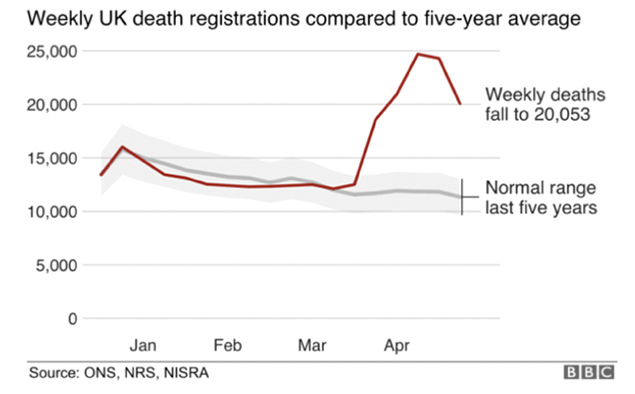
This illustrates the gap between Covid-19 identified deaths, the total number of deaths and the five-year average. Probably most of the excess should be recorded as direct Covid-19 deaths, some may be indirectly linked. This conveys a similar message:
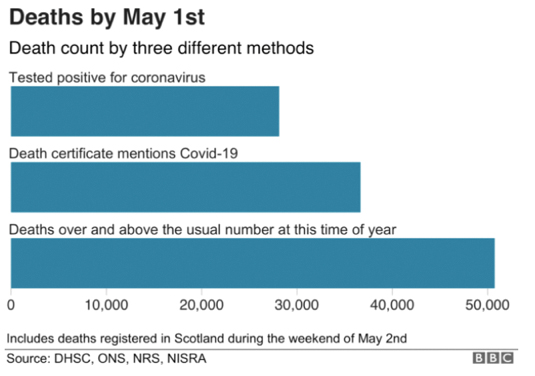
Note the number of different agencies involved: there is a great need for consistent central collection!
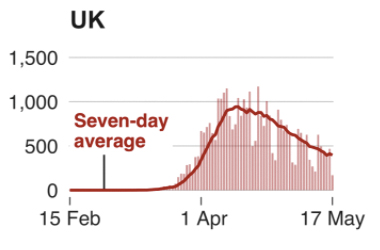
The above is the latest published data for the daily increase in deaths due to the virus in the UK. The solid line, the seven-day moving average, serves to smooth the data. Several things are immediately clear. We passed the peak on or around April 19/20. The rise and fall appear to be largely linear. So, the gradient, or the acceleration of deaths/day, can be measured, by eye and ruler, as around 57 deaths/day/day, with the recent slower fall of –21 deaths/day/day. If the trend is continued, then we can expect a very small or no daily increase at the end of the first week of June. Media commentators (and economists) generally use rates frequently, very few seem to understand the significance of the second derivative!
It is surprising how little is really known of Covid-19. One can sympathise with a government that is often hearing different expert opinion. Will there be a Covid-19 vaccine by the end of the year? We don’t know. What are the long-term health effects of having the novel coronavirus on those who get it? We don’t know. Is long-term immunity from the disease even possible? We don’t know. Could the novel coronavirus vanish unexpectedly? We don’t know. Are schools significant vectors of infection? Why is the UK death rate 52/100,000 people, compared with round 0.4 in many Asian countries? We don’t know. And so on…
There are some questions the answers to which are known by someone. Why was the UK so late in having health checks at its borders, particularly at airports with international entry? Why is quarantining those entering airports thought to be worthwhile from now? (Horses, stables?) Why has it taken so long to build up testing capability? Where did 2-metre social distancing come from? Why is the WHO recommending 1 metre? Why is the reason for the use of facemasks so uncertain? Why was so much reliance given to computer modelling when both the inputs to the modelling, the basis of the models and the quality of the programming appears to have been less than reliable? Why was PPE in such short supply at the beginning of the lockdown and why was its subsequent acquisition such an apparent shambles? Why were care homes such low priority in the early stages after it rapidly became obvious that older people were more vulnerable?
The mantra of “listening to the science” is misplaced. Medicine is certainly not science but is the art of dealing with multiple uncertainties and taking corrective actions based on experience. This situation has many parallels with the relationship between science and engineering.
What has been the effect on transport?
First, context:
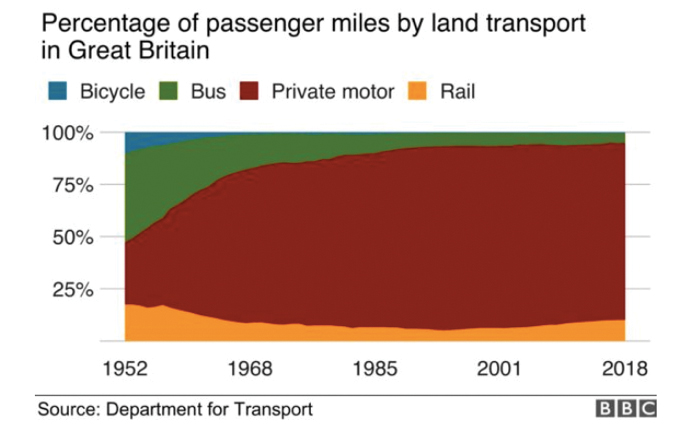
Although rail has doubled in the last 15 years, it still contributes a small fraction of our total mobility, whilst bus use has continued to diminish from the nearly 50% mode share in enjoyed in the early 50s to less than 5% now.
So, what has happened since the lock-down?
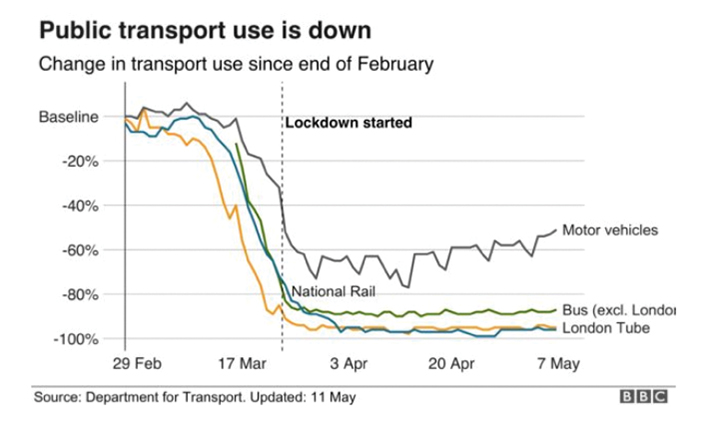
Not surprisingly, use of all modes has plummeted, but car use by less than the public modes and car use is now showing the greatest recovery rate.
London, as always, should be seen as a special case:
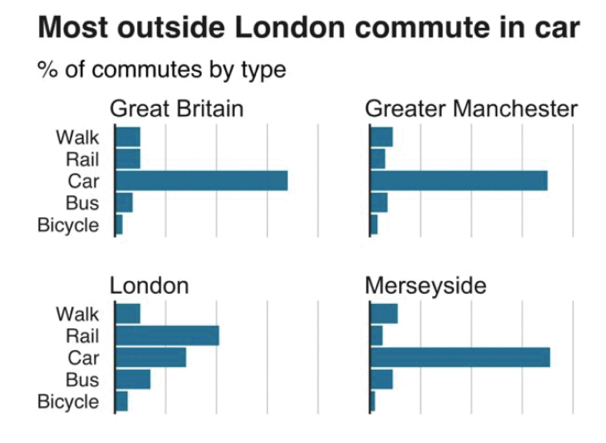
London has an exceptionally high use of rail for commuting. Consistently over the rest of the large cities, car is the predominant commuting choice.
So, the call of back to work if you can but avoid public transport, will be very difficult, if not impossible, in London. Elsewhere, it will be primarily by car. People’s perception of lack of safety will strengthen this trend and many will strenuously avoid travelling by bus or train. The suggestion that they can cycle or walk is mostly absurd and shows zero appreciation of reality. It may be a long time (several years?) before this effect is moderated, hampering aspirations of moving to a carbon free future, ironic since the decrease in air pollution is very evident and largely welcomed.
Air transport
A personal observation. When I returned to the UK at the beginning of March, I was astonished that no, even rudimentary, health checks were made at Heathrow, in contrast to Tokyo and Hong Kong from where I was returning.
Air transport has now been reduced to a tiny number of operations. Domestic air travel is so small as to be effectively zero. Most regional airports are effectively closed.
It is clear that there will be causalities both large and small amongst the airlines. Valuable planes are sitting earning no money, Rolls Royce has no engines to maintain and new aircraft will not be needed for many years as traffic recovers over an extended period (three to five years?). Virgin will most probably collapse, BA will shrink, many of the low-cost airlines will disappear, regional airports will close unless they can find other sources of income. It is most unlikely that a third runway will be needed at Heathrow for many years to come, etc. etc. The recent requirement of quarantine for arriving air passengers, arguably missing the boat by at least two months, will serve to further reduce the operations of airlines.
Implications for the future?
Who really knows in this unprecedented situation? But the following points are worthy of consideration:
- The economy is no longer subject to the ”normal” rules. Borrowing is huge but at low interest rates. Worrying about HMT Green Book is now largely irrelevant. Can we get our heads round a world where real growth is going to be extremely difficult to sustain in the long run?
- Car use will rapidly increase as the public shun public transport: this will, of course, have an adverse effect on the environment and our CO2 reduction ambitions.
- The collapse of the oil price has implications for the price of petrol and the increased attractiveness of car use.
- It is clear that there is very little appreciation of risk by the public at large and in government. In the world as a whole only 0.07% of the population has been infected. There have been a total of just over 300,000 deaths, 6.7% of those known to be infected, about 0.005% of the globe’s population. Comparisons with everyday risks such as cycling, excessive eating or drinking, seasonal flu epidemics, driving and so on now probably exceed the risk posed by the virus. But the public has little appreciation of this, and risk aversion may hamper the recovery. Politicians don’t understand the impossibility of the words ‘completely safe’. Nor, in general, do they and their advisors have the necessary quantitative background needed to manage this situation, or indeed, to govern a complex technological world.
- The economic basis of the present structure of the rail industry has disappeared. It is difficult to see franchising reappearing in its present form. Enforced low load factors (as low as 15%?) will mean rail will have to rely on huge subsidies even on previously well populated routes. Likewise, the public will shun buses, and low load factors will bring huge problems to local financing, (TfLondon running out of cash today). Social distancing spacing is vital here: 1 metre instead of 2 metres allows four times the density of people in a given space. The rationale behind whichever is chosen for the spacing distance has huge implications for the opening up of public transport, restaurants, pubs, etc.
- Air travel will be slow to recover. There will be huge job losses directly (BA, Virgin) and in the supply industry (Airbus, Rolls, Boeing). Many regional airports may close. It is unlikely that Heathrow will be expanded, Gatwick will have surplus capacity for many years. To rationalise the evolving situation, government should take control of the allocation of existing and future slots.
- It is regrettable that the component countries of the Union have, to some extent, ‘done their own thing’. It will likely speed the breakup of the Union as will our departure from the EU at the end of 2020 if a negotiated settlement cannot be reached.
- The internet has stood up much increased usage very well and has proved to be a vital lifeline for people in isolation. Likewise, the power supply industry has performed well assisted by relatively benign weather.
- In the short term, infrastructure resilience issues will be in danger of being side-lined. Future investments will have to compete with a huge clamour of calls for assistance from many quarters in the next few years.
Finally, my opinion of most of the media has not been enhanced by the extensive coverage. Far too much mawkish sentimentality, negativity, and hostile questioning from ignorant interviewers. Far too much time spend on endless speculative discussions and personalities (Imperial professor caught with trousers down…it wasn’t me!). Far too little good news to buoy up the population.
Rod A Smith
Director, FESI
Royal Academy of Engineering Network Rail Research Professor of Railway Engineering, Imperial College London
Chair of the Future Railway Research Centre
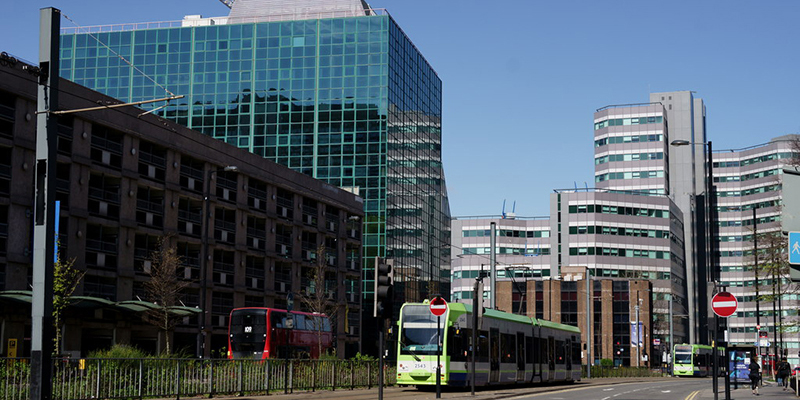
This article first appeared in the Summer 2020 issue of the The FESI Bulletin. The photograph shows Croydon, UK during COVID-19, with empty trams and buses hurrying through the deserted streets under a clear blue sky.