
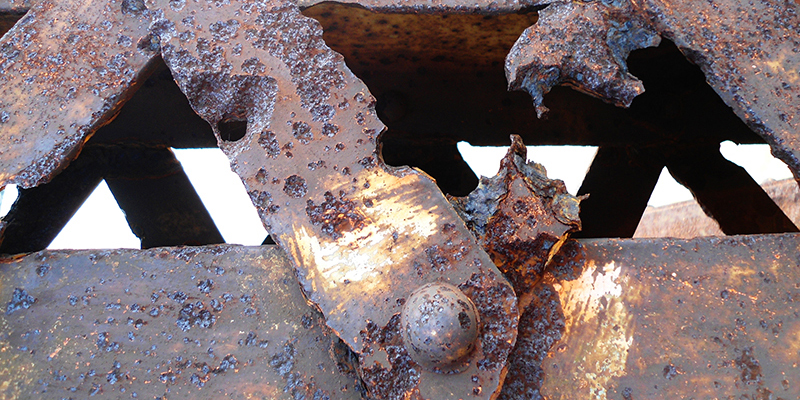
FESI and the University of Bristol have organised a workshop, to be held at the University of Bristol on October 25, 2022, that will explore the current state of pitting corrosion and pit-to-crack transition research for engineering materials from various sides and for different industrial environments. Its focus will be on the development of integrity approaches, new modelling techniques and experimental evidence supporting them to support the development of advanced pitting corrosion and pit-to-crack transition life estimations.
Pitting corrosion is one of the most damaging mechanisms affecting a range of industries, where components and structures, such as bridges, aircrafts and wind offshore infrastructure, are prone to premature failure. Assessment methods tend to be very conservative in most cases, leading to inefficient use of assets and premature retrieval of service. Testing, modelling and assessment approaches to reducing over-conservatism are being developed for more accurate life estimates and reduce conservatism.
In this workshop, researchers will be presenting recent advances in pitting corrosion experimental characterisation, modelling capabilities and assessment methods and highlighting some of the still unresolved knowledge gaps and challenges.
For further details, including registration, please refer to our workshop event page.
Nicolas Larrosa
Workshop Organiser
Speakers
Tamsin Dobson is a postgraduate research student in the Solid Mechanics research group of the University of Bristol. After spending over 10 years in the marine industry (interspersed with College lecturing positions), she developed her PhD research proposal from her work as part of the overseas in-service submarine support team at Babcock international and this was awarded a full EPSRC studentship and additional sponsorship from Babcock International. Her research interests include; marine corrosion, biofouling of metal structures, microstructure of Nickel Aluminium Bronze (NAB), fatigue and welding processes. She holds CEng with IMarEST and is the Honorary Secretary for the Southern Joint Branch of IMarEST and RINA.
Bob Akid is a former BP/Royal Academy of Engineering Chair in Corrosion & Materials. During his time working with British Steel, MoD and BP, he addressed a number of research issues related to corrosion, corrosion fatigue and hydrogen embrittlement mechanisms of steel pipelines and corrosion resistant alloys. He is a Fellow of The Institute of Materials, Minerals & Mining and currently resides as Emeritus Professor at the University of Manchester
Bernd Schönbauer is a senior scientist and lecturer at the Institute of Physics and Materials Science, University of Natural Resources and Life Sciences (BOKU), Vienna. His area of expertise is fatigue and fracture mechanics with focus on defect tolerance, loading condition and environmental effects in the high and very high cycle fatigue regime. He has been participating in several research projects funded by the government and private industry and serves
Ali Mehmanparast is a Professor of Structural Integrity at University of Strathclyde. He is a Chartered Engineer of IMechE, Fellow of The Higher Education Academy, Chartered Manager and Fellow of the Chartered Management Institute. Prof. Mehmanparast’s research is mainly focussed on the design optimisation, life extension and structural integrity assessment of Offshore Wind Turbines. Prof. Mehmanparast is the Co-Investigator and Manager of the Cranfield-Oxford-Strathclyde Universities EPSRC-funded Renewable Energy Marine Structures Centre for Doctoral Training (REMS CDT).
Emilio Martinez-Paneda is an Associate Professor (UK Senior Lecturer) in Mechanics of Materials at Imperial College London and UKRI Futures Leader Fellow. His research interests span a wide range of topics within applied mechanics, such as corrosion, iceberg calving, battery degradation, small scale plasticity, rock fracture, computational mechanics, hydrogen embrittlement and small-scale testing.
Dirk Engelberg is Professor in Materials Performance and Corrosion in the Department of Materials, The University of Manchester (UK). He has over 20 years’ experience in corrosion related research, focusing on the development and implementation of resilient approaches for the prediction, simulation, and mitigation of environment-assisted cracking. He is Director of the Materials Performance Centre (MPC), an internationally recognised center on nuclear materials research.
Nicolas Larrosa is Senior Lecturer in the School of Civil, Aerospace and Mechanical Engineering at the University of Bristol. His work focuses on materials, engineering, and structural integrity, supporting continued safe operation of nuclear, wind offshore and oil and gas industries. He is the founder of the Structural Integrity Course, the Director of Bristol Nuclear MSc, sits in various panels including BS 7910, BS 7608 and TAGSI and is a Fellow of the Institute of Materials, Minerals and Mining.