
This workshop–seminar, that was primarily organised by Professor Martyn Pavier, was attended by approximately 30 delegates from various industrial companies and universities on January 23, 2020 at the University of Bristol.
Morning Session
Professor Peter Flewitt, FESI Director and the University of Bristol, introduced the event by initially giving a brief outline of FESI followed by an outline of the structural integrity requirements and considerations that plant owners need to make in order for safe and economic production/operation to be satisfactorily achieved. He then went on to explain that future designs of power-generating plant (fossil, solar and nuclear) propose to go to temperatures of 750°C and pressures of 350 bar. There are thus challenges to achieve 60-year design lives. He stressed the importance of being able to achieve such long operating lives and improved efficiencies in order to reduce impact on climate change. There is the requirement for safe operation (particularly for nuclear plant) to be able to demonstrate no risk (or at least very low probability) of failure for safety-critical components. The main workshop objectives were highlighted as being to explore material options to be able to operate at these high temperatures (eg, nickel-base) and to explore engineering designs that may allow less-exotic materials to be used.
The first technical presentation was given by Professor Andy Morris of EDF Energy and Imperial College London on An Industry View on the Future Needs for High Temperature Plant. He explained that the existing conventional fossil fired power stations help to “keep the lights on” as EDF Energy transitions to new lower carbon generation and they have invested heavily to ensure that they meet all environmental regulations. EDF Energy closed their 2,000 MW Cottam coal fired site in September 2019 after 51 years of generation, supplying approximately 3.7 million UK homes. Safe operation of high temperature generating plant requires a holistic approach to inspection, assessment and the ability to respond to changing regulations and market demands. Professor Morris consequently explained the context of the current journey through the transition to lower carbon generation, providing examples of some of EDF Energy’s new generation assets to frame the competition in the market. He went on to explain that the many years of operation of conventional fossil-fired power plants has provided numerous technical challenges with respect to how the integrity of high energy, high temperature pressure systems are managed. He covered, with examples, some of the key learning points such as design code limitations, fabrication issues, operational considerations and the pros and cons of the current inspection based assessment approaches routinely adopted. As coal fired power stations approach closure, Combined Cycle Gas Turbine (CCGT) generation will continue as an important part of the transition in the UK. Therefore, the future challenges associated with operation for this type of power station and high temperature materials were highlighted. Professor Morris finally gave a brief outline of some key current research projects that are underway in order to provide an insight into how EDF Energy intend to address some of the challenges associated with CCGT plant high temperature materials going forward and learning points from the past.
The second technical presentation was given by Professor Bo Chen of the University of Leicester on Engineering and Materials Challenges for Gen IV. Professor Chen firstly listed the main six Gen IV nuclear reactor systems that are being considered; Very High Temperature Reactor (VHTR), Sodium Cooled Fast Reactor (SFR), Super Cooled Water Reactor (SCWR), Gas Cooled Fast Reactor (GFR), Lead Cooled Fast Reactor (LFR) and Molten Salt Reactor (MSR). He noted that for all of these systems, austenitic stainless steel would be a prominent material. He also noted that there was significant experience within the UK in relation to materials and structural integrity (eg, creep-fatigue) issues associated with these high temperature reactor systems. Professor Chen highlighted the importance of the PRISM and ASTRID international collaborative projects associated with Gen IV. He explained that he considered one of the key challenges going forward was the development of mechanistic-based prediction methods for long-term creep-fatigue life. This would necessitate relevant time dependent creep and creep-fatigue data to be generated and for neutron irradiation damage to be able to be accurately quantified. He then went on to highlight the Fellowship he is currently engaged in whereby he is liaising with relevant researchers in the UK, Europe and China in trying to cement/combine all technical aspects together which would also include fracture behaviour under creep-fatigue conditions. He explained that he was heavily involved in structural integrity aspects relating to advanced manufacturing methods, particularly Additive Manufacturing.
The third presentation was given by Professor Grace Burke of the University of Manchester on Potential Solutions for Gen IV. Professor Burke noted that she was the UK representative on the Gen IV International Forum (GIF). Particularly focussing on SFR and VHTR systems, she explained that the challenging operating environments meant that the testing requirements to obtain relevant and necessary materials data would also be challenging. This is particularly true when considering irradiation effects. She mentioned that from a UK perspective, Gen IV reactors would likely to be AMRs (Advanced Modular Reactors). She mentioned that the dose for PWR reactors was typically 100 dpa whereas for some Gen IV systems, it could be double this value. Professor Burke said that she considered the main degradation methods for Gen IV systems to be creep-fatigue, hydrogen embrittlement, environmental assisted cracking (corrosion-fatigue and stress corrosion cracking) and irradiation embrittlement. She thought that the logic for developing a materials properties experimental programme would sensibly be Base Materials Properties followed by Inclusion of Environmental Effects followed by Inclusion of Irradiation Effects. Professor Burke emphasised the usefulness of testing samples from material extracted from decommissioned plant and noted the importance of being able to understand material variability in relation to the evaluation and use of material properties.
The fourth and final morning technical presentation was given by Professor George Smith of Oxford University on Engineering and Materials Challenges for Fusion. Professor Smith gave a fairly comprehensive explanation of the basis of fusion reactors. He then went on to explain that the development of future nuclear fusion energy systems involves a plethora of engineering and materials challenges, ranging from the initial containment of highly energetic plasms to the minimisation of radioactive waste materials at the end of plant life. In between these two time extremes, there are major operational challenges involving intense irradiation of construction materials by high-energy neutrons; radiation shielding of critical components such as superconducting thermal and electric shocks; sputtering, erosion and re-deposition of materials from plasma-facing components; the development of tritium handling and breeding systems; development of a range of monitoring and diagnostic systems for use in very hostile environments; and demonstration of total system resilience against a range of possible accident scenarios. Professor Smith explained that there are many attractions in seeking to develop the necessary engineering and materials technologies using small-scale systems, instead of very large ones. In this context, the Spherical Tokamak (ST) has particular advantages. The ST is very compact, makes optimum use of the available magnetic fields for plasma compression, and requires minimum input energy for its operation. However, its compact design means that there is only limited space within the reaction chamber for critical components. An area where space is particularly restricted is the central column shield, which protects the superconducting toroidal magnet coils from radiation-induced damage. Numerical studies of neutron attenuation in candidate shielding materials suggest that tungsten carbide has outstanding performance in this respect. The development of modern spark-plasma sintering techniques has enabled monolithic WC (Tungsten-Carbide) materials to be developed and enhanced thermal and electrical conductivity. The implications of this improvement on the material’s plasma facing properties have been evaluated using electron beam heating to simulate plasma-induced thermal shock. It is considered that a cermet material, WC-FeCr, may be better suited for other structural components of the shield. This material consists of Particulate WC, embedded in a small volume fraction of a metallic FeCr matrix. This microstructure provides enhanced mechanical properties, extending the load-bearing capacity of the shield. Radiation protection can be further enhanced by the introduction of a boride layer, close to the superconductor coils. Experimental studies of these materials are being undertaken at Imperial College. Investigations of their stability under ion irradiation, and under possible loss-of-coolant accident conditions were described by Professor Smith.
Afternoon Session
The afternoon of the event consisted of an extensive presentation followed by a general discussion period.
The extensive presentation was on Engineering Solutions for High Temperature Plant, split into three separate parts given by Professor Martyn Pavier of the University of Bristol, Dr Mike Tierney of the University of Bristol and Dr Stefano Mori of Cranfield University. The item was associated with a collaborative development programme centred on a proposed plant design to allow steam pipes to be operated at much higher temperatures than at present but still to be made of steel. The background to the project was explained by Professor Pavier. This was that proposed advanced-ultra super critical plant (A-USC) achieve cycle efficiencies as high as 55%, about 15% greater than typical conventional plants. Similar aspirations are under consideration for Gen IV nuclear plant. Unfortunately, the alloys suitable for the required greater temperatures of the order of 720°C are limited to higher cost austenitic stainless steels and nickel base alloys, to ensure that the required mechanical properties, creep strength and corrosion resistance are sufficient to provide practical design service lives. The proposed design is of a steel pipe with a ceramic thermal insulation coating (TIC) on the internal surface and cooling on its outer surface provided by exhaust steam from the turbines. The arrangement could potentially limit the temperatures of the transport pipes to no more than 620°C, typical of plants operating today.
As presented by Dr Tierney, the University of Bristol had developed a thermodynamic model of the proposed steam cycle. The model calculates the rate of transfer of heat from the superheated steam through the TIC into the steel pipe, and then the rate of heat transfer to the reheat steam returning to the boiler being used to cool the steam pipe. The model predicts the maximum steam and metal temperatures within the novel steam pipe system and the resulting efficiency of the plant, compared to that of a conventional design without cooling.
As presented by Dr Mori, Cranfield University had carried out steam oxidation testing of candidate TIC materials (ceramic layers and bond coatings) at ultra-supercritical steam temperatures. The results of this steam oxidation testing can be used to identify potential failure mechanisms for candidate TIC systems and provide estimates for their lifetimes in practical power generation systems.
Unfortunately, nobody from the University of Nottingham was able to attend the event but, as briefly presented by Professor Pavier, that university had investigated the structural integrity of the coating and the steel pipe. Stresses are generated in the TIC and steel during start-ups, shut-downs and steady state operation. These stresses will be very different in character from those in conventional steam transport. The investigation had used existing computational models of the properties of TIC and steel to predict their lifetime under realistic operation conditions.
In bringing the event to a conclusion, there was a useful discussion session led by Professor Morris.
Workshop Takeaways
- Cost cutting is always one of the drivers nowadays in the power generation industry
- Innovation is therefore clearly a key consideration in order to minimise cost
- Future power generation is likely to comprise a mixture of renewable and nuclear systems
- Future power generation systems are likely to be a mix of being relatively small (e.g. Small Modular Reactors) and larger units
- Aspects relating to the national grid system will be an important consideration
- There is clearly a significant gap in materials behaviour knowledge for nuclear Gen IV systems which operate at high temperatures
- Condition monitoring and inspection will play an increasingly important role going forward
- Particularly for smaller unit designs, accessibility for inspection will be challenging
- Experience could usefully be gained from different industrial sectors in relation to materials aspects
- Knowledge transfer from senior technical experts in the power generation industry needs to be seriously enhanced before it is “too late”
- The detailed archiving of all relevant information and material data need to be enhanced (*it was noted that EPSRC are funding a review of the challenges and need to archive service exposed and test specimens of pedigree irradiated nuclear materials; programme undertaken jointly by UKAEA and University of Bristol)
- All data should be stored irrespective of whether or not they are required to be used in the short term as they may be important in the long term
- Serious consideration needs to be given to ensure that archiving and data storage will be accessible by future computer software and hardware versions/developments
John Sharples
Wood Nuclear and FESI Chief Technical Advisor
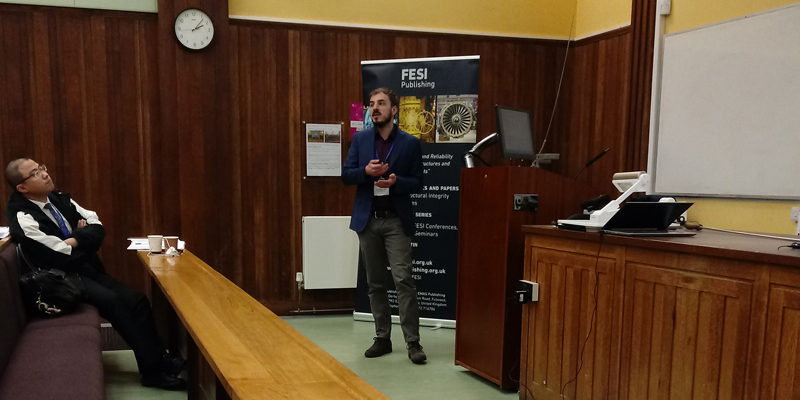
The photograph shows Dr Stefano Mori of Cranfield University, whose lecture formed part of an extensive presentation on Engineering Solutions for High Temperature Plant.